




Skip to Content

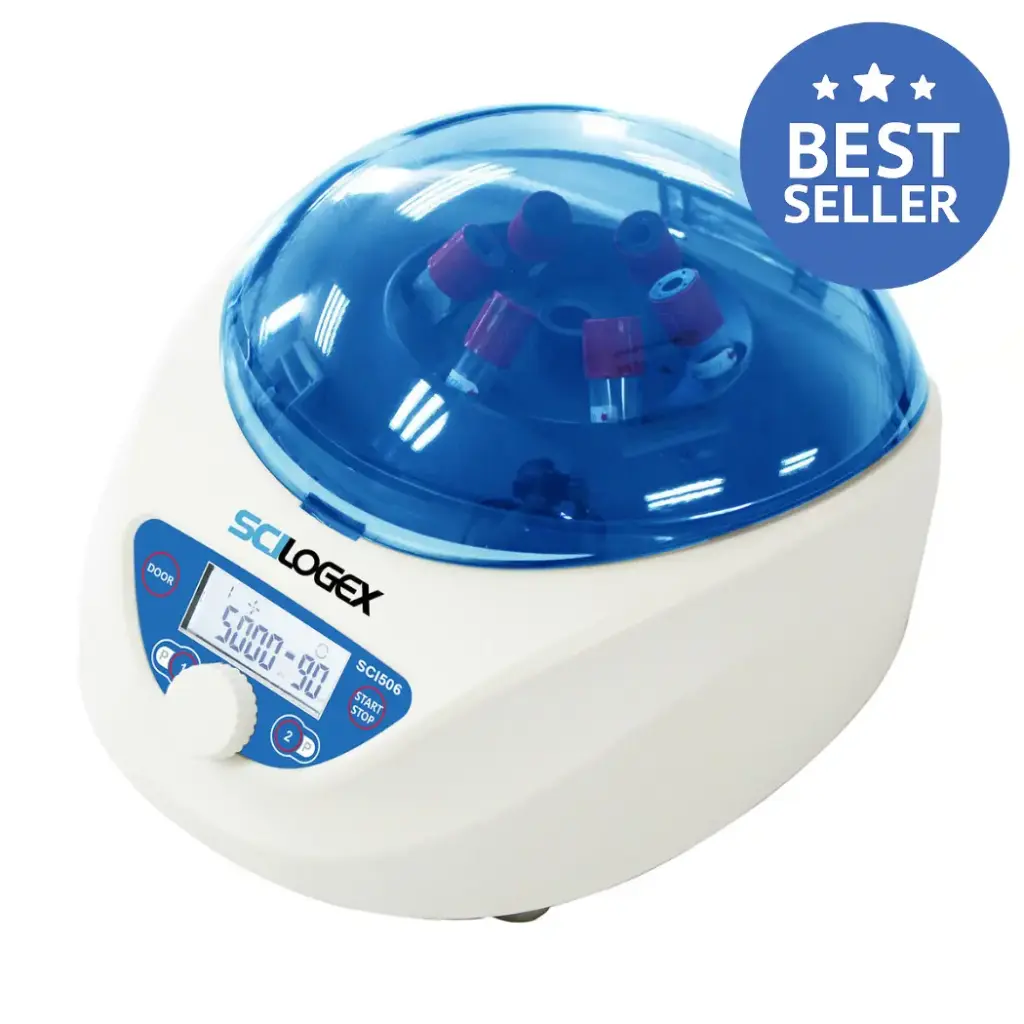
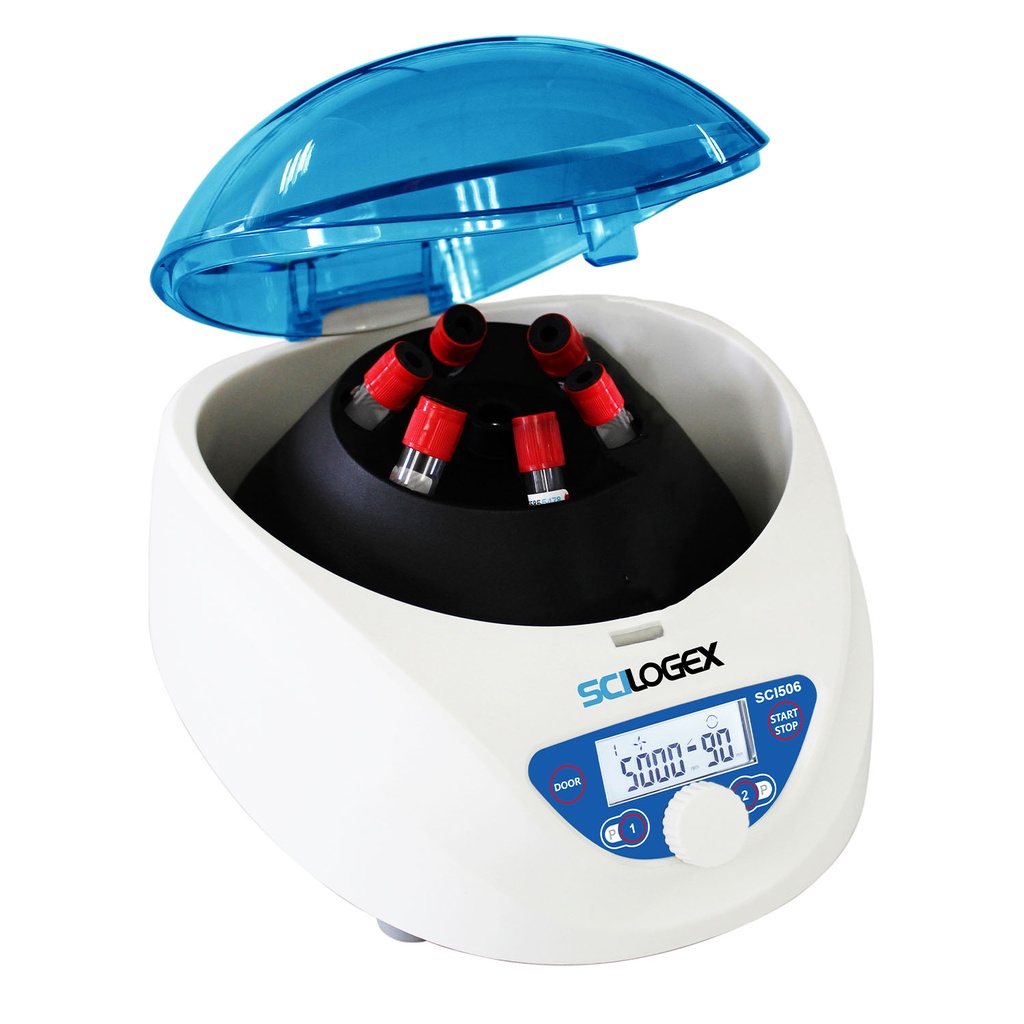
SCILOGEX SCI506 Low-Speed Centrifuge, 6 x 1.5-15ml capacity, 300-5000rpm

Cat. No.
913053419999
https://www.scilogex.com/web/image/product.template/1221/image_1920?unique=8a02977
The SCILOGEX SCI506 low-speed centrifuge is supplied with a fixed angle rotor which can hold up to 6x3-10mL blood/Vacutainer tubes 6x1.5-2.0mL centrifuge tubes, 6x5mL Eppendorf style tubes, 6x15mL centrifuge tubes (adapters included).

520.00 520.00 In stock
In Stock 2 Year Warranty

Weight: 6.35 kg

324.00

Currently Out-of-Stock

This combination does not exist.

In Stock 2 Year Warranty


For more information please call +1 (860) 436-9221 or email us at [email protected]

Get the best price
for your organization today

Low speed centrifuge

Your blood and urine samples need consistent separation - not vanity features that waste budget. The Scilogex SCI506 is a 6-place low speed centrifuge with 300-5000 RPM for $520.


300-5000 RPM with 2350 x g 
max RCF

Keep more budget for reagents and consumables


6-place rotor handles 1.5mL to 15mL tubes

Handles your full range of common tube formats without swapping rotors


Brushless DC motor with no scheduled maintenance

No brush replacements, no downtime, no service contracts


Optional 12V DC adapter for field use

Take it to the field without a power outlet


Scilogex SCI506 low speed centrifuge at a glance

  What is this product?

The Scilogex SCI506 is a 6-place low speed centrifuge with a fixed angle rotor capable of 300-5000 RPM (2350 x g max). It accepts 1.5mL, 2.0mL, 5mL, 10mL, and 15mL tubes, and blood/Vacutainer tubes. Adapters are included. An optional 12V DC car adapter is available for field use.

   Who is it for?

Lab technicians, clinicians, and researchers in hospitals, outpatient clinics, veterinary practices, dental offices, and research institutes who need reliable low-speed centrifugation for routine separations without paying premium brand prices. Also useful for new labs building out their benchtop equipment within a budget.

   What does it do?

Separates blood into serum and plasma, processes urine samples, pellets cells and bacteria at low speed, and prepares PRP and PRF. Handles virtually all common low-speed centrifugation tasks in clinical and research settings.

   What are the benefits in your workplace?

Two programmable memories save your most-used settings. Two deceleration settings protect delicate separations. Speed or RCF display lets you match protocol requirements directly. Brushless motor requires no maintenance. 2-year warranty means predictable costs. $520 price point leaves budget for other lab priorities.

   What problems does it solve?

Overpaying for low-speed centrifuge features your protocols don't need. Dealing with brushed motors that eventually fail and require service. Juggling multiple tube formats with incompatible rotor systems. Needing a centrifuge for occasional field work or remote sampling sites.

   What are your next steps?

Add to your cart now, or contact us for volume pricing if you're equipping multiple stations.

Whether you're separating blood in a clinical lab, preparing PRP in a dental practice, or processing urine samples in a hospital, your low speed centrifuge needs to spin reliably and hold the speeds your protocols require. The SCI506 does that consistently - without the pricing that forces you to justify every equipment decision to your department head.


Models suitable for…

Clinical and hospital labs
Environmental monitoring
Dental and orthopedic practices
Pharmaceutical & biotech research
Research institutes

Veterinary clinics

 Why the Scilogex SCI506 low speed centrifuge makes sense for most labs

 This is for labs that run separations, not for labs that collect equipment brand names

 Your serum doesn't care what brand name is on the centrifuge housing. It cares whether the rotor hits its programmed speed and holds it. The SCI506 gives you 300-5000 RPM in 10 RPM increments, two programmable run memories, and a brushless motor that won't need a service call at an inconvenient time.

Why choose this low speed centrifuge for your lab? 

  • Two programmable memories. Set your most common protocols once. No re-entering speed, time, and deceleration settings every run.
  • Two deceleration settings. Some applications - buffy coat separations, PRP preparation - need a slow, gentle deceleration to keep the layers intact. Others don't. Having the choice matters.
  • Speed or RCF display. If your protocol specifies g-force, you can set and read in x g directly. If it specifies RPM, you can do that too. Either way, you're not doing mental math.
  • Brushless DC motor. No brush replacements, no scheduled service. It runs.
  • Automatic lid-lock release. The lid doesn't unlock until the rotor has stopped. Simple, but important for safe operation.
  • 12V DC car adapter option. For mobile blood banking, field sampling, or any situation where you need centrifugation away from a standard outlet.


Why do your colleagues choose Scilogex over premium low speed centrifuge brands?

Lab technicians and clinical staff

Identical separation results

The physics of centrifugation doesn't change with the brand name. 2350 x g in a $520 Scilogex produces the same serum or plasma as 2350 x g in a $1,200 premium centrifuge. Clinical staff switching from more expensive brands report no change in their results - just more flexibility in the equipment budget. 

Equipment that just runs

Clinical labs need equipment that doesn't require attention between uses. The SCI506's brushless motor and two-setting deceleration cover the daily routine without surprises. When your centrifuge works predictably, your technician can focus on the sample, not the machine. 

Principal investigators and lab managers

Budget flexibility

The savings between a Scilogex SCI506 and a comparable premium clinical centrifuge can cover several months of consumables, or another piece of benchtop equipment your lab actually needs. Thoughtful purchasing means a better-equipped lab overall. 

Predictable costs

The 2-year warranty and brushless motor design remove surprise repair bills from your budget planning. You know what you're paying upfront, and you're not managing a service contract on top of the purchase price. 

Defensible purchasing decisions

When procurement asks why you chose this over a premium brand, the answer is straightforward: the SCI506 meets your protocols at roughly half the price of alternatives with equivalent specs. 


Where is the SCI506 low speed centrifuge being used today? 

Clinical blood separation

Most routine clinical centrifugation happens at low speed. The SCI506 handles serum separation for chemistry panels, plasma preparation for coagulation studies, blood banking sample processing, and pre-analytical sample preparation for analyzers. At 2350 x g max and a 6-place rotor for standard Vacutainer tubes, it covers the daily workload in a typical clinical setting.


PRP and PRF preparation

Platelet-rich plasma and platelet-rich fibrin have become standard procedures in dental, orthopedic, and aesthetic medicine. Both require precise low-speed centrifugation - too fast destroys platelets, too slow leaves them in suspension. The two deceleration settings give you control over the critical deceleration phase that affects the quality of your final product.


Urine analysis

Urine microscopy requires pelleting sediment before examination. The SCI506's 300-5000 RPM range and adjustable deceleration allow gentle, reproducible pelleting without breaking up formed elements in the sediment. Consistent protocols across runs mean consistent results - which matters when you're tracking changes in a patient's urine over time.


Cell pelleting and washing

Research labs use low speed centrifugation to harvest cells from culture media, wash cell pellets between steps, and prepare single-cell suspensions. The SCI506 handles 1.5mL through 15mL tube formats, which covers most standard cell culture workflows without needing a separate rotor or centrifuge for different tube sizes.


Bacterial and yeast culture work

Microbiology labs routinely pellet bacteria and yeast from liquid cultures for downstream work - DNA extraction, protein isolation, enzyme assays. Low speed centrifugation at a few thousand RPM is sufficient and avoids the cell disruption that can occur with excessive g-force. The SCI506 handles this without occupying a high-speed instrument that other protocols may need.


Field and mobile sampling

The optional 12V DC car adapter makes the SCI506 one of the few low speed centrifuges that can function away from a standard power outlet. Veterinary field work, remote blood banking, agricultural research sampling, and disaster response applications all benefit from a centrifuge that can run from a vehicle battery.


 How does this compare to Thermo Fisher and Eppendorf low speed centrifuge models?

When evaluating low speed centrifuges, labs often default to Thermo Fisher or Eppendorf based on brand recognition. Here's an honest look at what those brands offer versus what you actually need. 

What we're not trying to be

The Scilogex SCI506 is not a floor-standing high-capacity centrifuge. It won't run 24 x 50mL tubes simultaneously or interface with a LIMS system. If your workflow requires large batch processing, walk-away programming, or GMP-compliant data logging, a clinical floor model or a more sophisticated benchtop unit is the right tool.

What the SCI506 actually delivers

For the core function of a low speed centrifuge - consistent speed control across a range of common tube formats with reproducible deceleration - the SCI506 covers what most routine lab and clinical workflows require.


Feature Scilogex SCI506 Comparable premium models
Speed range 300-5000 RPM 200-6000 RPM typical
Max RCF 2350 x g 2500-3500 x g typical
Tube capacity 6-place 6-12 place typical
Tube formats 1.5mL to 15mL + Vacutainer Similar range
Motor type Brushless DC Brushless DC
Programmable memories 2 2-10 depending on model
Field/DC use Optional 12V adapter Rarely available
Price $520 $900-$2,000+

 The math is direct

The SCI506 handles standard blood, urine, and cell pelleting protocols identically to premium alternatives at this speed range. The savings - often $400-$1,500 per unit - go back to your lab budget rather than to premium brand overhead. 

 When the premium brands are worth it

You need more than 6-place capacity and need to run large batches simultaneously.

Your protocols require speeds above 5000 RPM in the same instrument.

You need extensive programmable profiles for complex or validated methods.

You have institutional purchasing agreements that require specific vendors.

 For the majority of routine low-speed work, you're paying for the name, not for better centrifugation.


How to choose a low speed centrifuge

1. Confirm your speed and RCF requirements

Most clinical separations and standard cell pelleting happen between 1000-3000 RPM (roughly 400-2000 x g). The SCI506's 300-5000 RPM range with 2350 x g maximum covers this comfortably. If your protocols consistently require higher g-forces, look at higher-capacity models.

2. Match your tube formats

The SCI506 accepts 1.5mL, 2.0mL, 5mL, 10mL, and 15mL tubes, plus 3-10mL blood/Vacutainer tubes. Adapters are included. If you primarily work within these formats, you won't need a separate rotor or a second instrument for different tube sizes.

3. Consider deceleration control

Gentle deceleration is not a minor detail for some applications. PRP and PRF preparation specifically require slow, controlled deceleration to prevent disturbing the platelet layer. The SCI506 gives you two deceleration settings to match your protocol requirements.

4. Decide on field capability

Most low speed centrifuges are bench-only instruments. If you have any need for mobile or field centrifugation - veterinary house calls, remote sampling sites, emergency field work - the SCI506's optional 12V DC adapter is a practical feature that most competitors in this price category don't offer.

5. Evaluate total cost of ownership

At $520 with a brushless motor and 2-year warranty, the SCI506's total cost of ownership is low. No scheduled brush replacements, no annual service contracts, and a warranty period that covers typical early-life failures.


 What determines low speed centrifuge price?​

Speed range and RCF capability​

Higher maximum speeds and g-forces require stronger rotors and motor assemblies. For routine low-speed work (blood separation, cell pelleting), this premium rarely translates to better results. The SCI506's 2350 x g ceiling covers the practical range for most applications. 

Rotor capacity

More tube positions mean larger, heavier rotors and larger housings. Six-place capacity covers most benchtop clinical and research workflows. Higher-capacity rotors add cost without benefit if you're routinely running 6 or fewer samples.

Motor type

Brushless DC motors have higher upfront cost than brushed motors but eliminate ongoing maintenance requirements. The SCI506 uses brushless DC, which keeps long-term costs predictable. 

Programmable features​

More memory slots, programmable profiles, and data logging capability add cost. Two memory programs cover most routine applications without adding complexity or price.

Safety and control systems

Door interlocks, lid-lock release, over-speed protection, and sound alerts are standard on modern centrifuges and worth having. These are included on the SCI506 without a premium pricing tier. 

Brand premium

Premium brands price their centrifuges to support global service networks, marketing infrastructure, and brand positioning. These costs are reflected in the purchase price without improving centrifugation performance. 

Warranty and reliability

 A 2-year warranty signals manufacturing confidence. The SCI506 carries a 2-year warranty at $520 - comparable to what premium brands offer at 2-3x the price.


SCI506 specifications

Feature Specification
Speed range 300-5000 RPM (10 RPM increments)
Max RCF 2350 x g (10 x g increments)
Speed accuracy ±20 RPM
Rotor type Fixed angle, 6-place
Tube compatibility 6 x 3-10mL blood/Vacutainer tubes; 6 x 1.5-2.0mL centrifuge tubes; 6 x 5mL Eppendorf-style tubes; 6 x 15mL centrifuge tubes (adapters included)
Inner/outer radius 93mm inner / 96mm outer
Run time 30 seconds to 99 minutes, or continuous (HD)
Acceleration settings 1
Deceleration settings 2
Program memory 2
Display Easy-read digital display (RPM or x g)
Advanced features Speed/RCF switch, sound alert, automatic lid-lock release
Voltage 110-220V, 50/60Hz
Dimensions 12" L x 9" W x 7" H
Weight 11 lbs (6.35 kg)
Optional accessory 12V DC car adapter
Certifications CE
Warranty 2 years
Price $520

Included with purchase:

  • SCI506 low speed centrifuge
  • Fixed angle 6-place rotor
  • Tube adapters (1.5mL, 2.0mL, 5mL, 10mL, 15mL)
  • Power cord
  • User manual

Add to cart - $520


Low speed centrifuge frequently asked questions

Product and purchasing questions

 The SCI506 includes a fixed angle 6-place rotor with adapters for 1.5-2.0mL centrifuge tubes, 5mL Eppendorf-style tubes, 3-10mL blood/Vacutainer tubes, and 15mL centrifuge tubes. All adapters are included with purchase.

The SCI506 comes with the centrifuge, the 6-place fixed angle rotor, tube adapters for the supported formats, power cord, and user manual. The optional 12V DC car adapter is available separately.

The SCI506 operates on 110-220V, 50/60Hz, making it compatible with both North American and international power supplies.

The SCI506 comes with a 2-year warranty covering manufacturing defects and component failures under normal operating conditions.

Yes. An optional 12V DC car adapter is available separately, allowing the SCI506 to operate from a vehicle battery or other 12V DC source.

At $520, the SCI506 is priced well below comparable clinical low speed centrifuges from premium brands, which typically range from $900 to $2,000+ for similar specifications. The savings represent budget that stays in your lab.

Technical and application questions

The two deceleration settings let you choose between a faster stop and a slower, more gradual deceleration. For applications like PRP and PRF preparation, a slow deceleration is essential to avoid disturbing the platelet layer that forms during the centrifuge run. For most standard separations, a faster stop is fine. Having both options in one instrument covers both types of work.

Yes. The display and input can be switched between RPM and x g (RCF). If your protocol specifies 400 x g, you can set 400 x g directly rather than converting to RPM.

The SCI506 stores two complete programs. Each program stores your speed, run time, and deceleration setting. For labs with a small number of recurring protocols, two programs cover the daily routine without constant re-entry.

The SCI506 is designed to use its included fixed angle rotor with the supported tube formats via adapters. Contact Scilogex directly if you have specific questions about rotor compatibility with other configurations.

Yes. The HD (continuous) setting allows the centrifuge to run indefinitely rather than stopping at the end of a timed run. This is useful for extended separations or situations where you want manual control over when the run ends.

The brushless DC motor runs quietly enough for normal lab bench use without interfering with adjacent work.

Comparison questions

A microcentrifuge is designed for small tubes (typically 0.2-2.0mL) at high speeds (up to 10,000-15,000+ RPM) and high g-forces. A low speed centrifuge covers a wider range of tube sizes - from microcentrifuge tubes up to 15mL or larger conical tubes - at lower maximum speeds (usually up to 5000-6000 RPM). For clinical separations and most cell culture pelleting, low speed is sufficient and more appropriate.

If your protocols require high g-forces for applications like subcellular fractionation, density gradient separations, nucleic acid precipitations, or pelleting of very small particles (cell membranes, ribosomes), you'll need a higher-speed instrument. For standard blood separation, urine analysis, and cell pelleting at typical culture scales, a low speed centrifuge is the right tool.

Yes. PRP preparation is one of the primary applications for this type of low speed centrifuge. The protocol typically involves two centrifuge runs at defined speeds, with the quality of the final PRP concentrate depending on consistent speed control and a controlled final deceleration. The SCI506's two deceleration settings address the deceleration requirement directly.

The SCI506 covers the same basic clinical and research low-speed centrifugation applications as Thermo Fisher clinical models at roughly half to one-third the price. Premium brands offer larger rotor capacities, more programmable memory slots, and more extensive service infrastructure. For a 6-place benchtop workflow, those additional features don't affect your results - just your purchase price.

The SCI506 is affordable, not cheap. Cheap equipment cuts corners on components. The SCI506 uses a brushless DC motor, a machined fixed angle rotor, and digital speed control with an automatic lid-lock release - the same engineering decisions you find in centrifuges that cost twice as much. You're not paying for premium brand overhead. That's a different thing.

Low speed centrifuge basics

A low speed centrifuge is a laboratory instrument that spins samples at relatively low rotational speeds - typically up to 5000-6000 RPM and up to a few thousand x g - to separate components by density. They're used primarily in clinical settings for blood and urine processing, in research labs for cell pelleting and washing, and in dental and orthopedic applications for PRP and PRF preparation. They accept a wider range of tube sizes than high-speed microcentrifuges and are designed for the tube formats commonly used in clinical workflows.

PRP (platelet-rich plasma) is a concentrated plasma fraction prepared from a patient's own blood, used in dental, orthopedic, and aesthetic procedures for its growth factor content. PRP preparation requires centrifuging blood at a specific low speed to separate red blood cells, platelet-rich plasma, and platelet-poor plasma into distinct layers, then collecting the middle platelet-rich layer. High speed would pellet the platelets rather than concentrate them, so low speed centrifugation is specifically required.

RPM is the raw rotational speed - revolutions per minute. RCF (relative centrifugal force, expressed as x g, or multiples of gravitational force) accounts for rotor radius and is the actual force acting on your sample. The same RPM in a larger rotor produces more g-force than in a smaller rotor. Most lab protocols specify either RPM or RCF, and being able to set and read either directly - as the SCI506 allows - removes one potential source of protocol error.


Additional Resources and Information

Downloadable PDFs


SCILOGEX SCI506 Digital Clinical Centrifuge Manual


SCILOGEX SCI506 Clinical Centrifuge Brochure


SCILOGEX Centrifuges Brochure

Product Accessories

Our latest content

Check out what's new in our company !

Your Dynamic Snippet will be displayed here... This message is displayed because you did not provide both a filter and a template to use.
View our 2025 Product Catalog

Get our complete and latest product portfolio for free.

View Scilogex Catalog Now

Earn Rewards

Enjoy exclusive deals & discounts on our lab equipment & supplies.

Start Earning Points​​​

Download Scilogex Literature

Find a collection of product manuals and brochure PDFs available for download.

Browse Here